
AI Filmmaking in 2026: What's Real, What's Hype, and What Actually Ships
Sora is dead. Costs dropped 91%. The market hit $946 million. But nobody has shipped a watchable AI feature film. A filmmaker's honest breakdown of where we actually stand.

The state of play: September 2026
Let me give you the honest version of where AI filmmaking stands right now, because the marketing from every AI video company and the doomsaying from every film industry trade publication are both wrong in equal measure.
The AI video generation market reached $946 million in 2026, up from $716.8 million in 2025 (Toolixlab, 2026). Monthly active users across AI video platforms surpassed 124 million. Venture capital poured $4.7 billion into AI video startups in 2025 alone, a 189% increase from 2023. 78% of marketing teams now use AI-generated video in at least one campaign per quarter.
Those numbers are real. But they describe marketing videos, social clips, and ad creative. Not cinema.
The film industry reality is messier. Approximately 75% of studios now run two or three AI video platforms simultaneously rather than committing to one (Ainvasion, 2026). That's not a ringing endorsement. That's an industry collectively hedging because no single tool is good enough at everything yet.
The Sora autopsy: what the most hyped AI product taught us
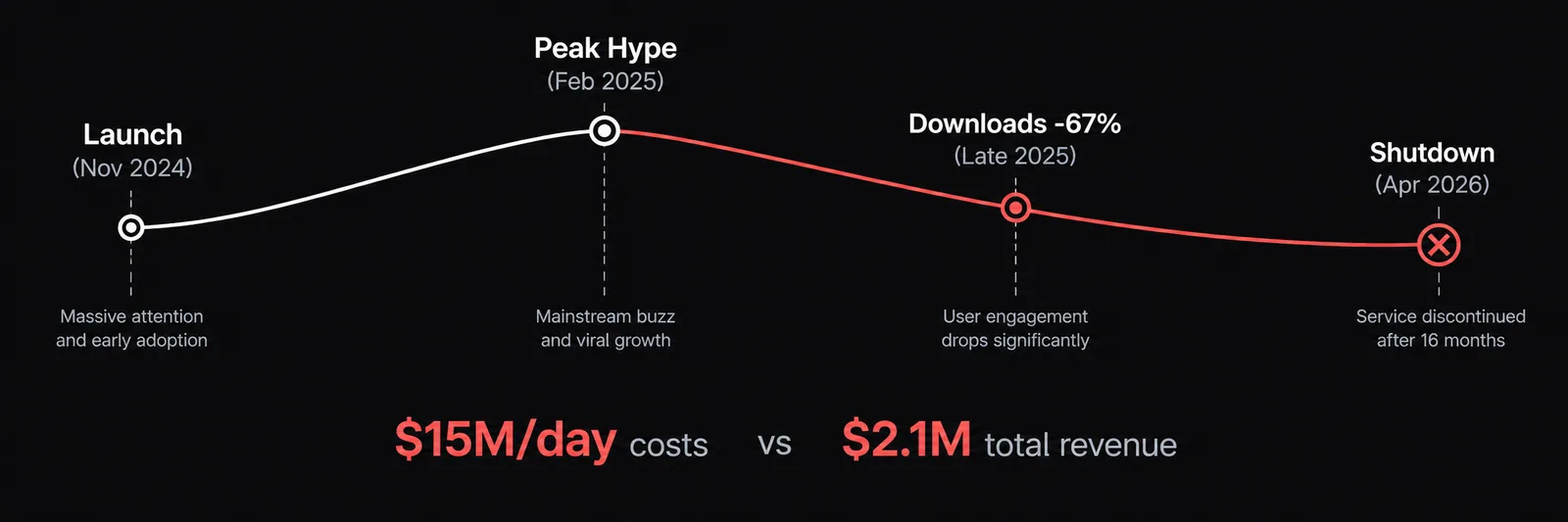
On April 26, 2026, OpenAI shut down the standalone Sora app. The most hyped AI video product of 2024 died 18 months after launch.
The numbers tell the story clearly. Sora was hemorrhaging $15 million per day in compute costs against $2.1 million in total lifetime revenue. Downloads had dropped 67% from their November 2025 peak. Generation times of 3 to 8 minutes for a 10-second clip were uncompetitive when Runway and Kling had reduced that to under 90 seconds.
Sora failed for three specific reasons that matter for anyone thinking about AI filmmaking:
- Pricing that didn't match usage patterns. Fixed subscription credits limited the repetitive experimentation that professional creators depend on. Runway and Kling moved to per-second-of-output pricing, which scales with production volume.
- Speed that killed iteration. Filmmaking is iterative. You generate, evaluate, adjust, regenerate. An 8-minute generation cycle for a 10-second clip makes iteration painful. Sub-90-second cycles make it viable.
- No editing pipeline. Sora generated clips. It did not plan, did not edit, did not assemble. Every clip needed to go somewhere else for anything useful to happen. The tools that survived are the ones that connected generation to a real workflow.
Sora's death was not the end of AI video. It was the end of the "generate a clip and be amazed" era. The market that emerged after is healthier, more competitive, and more focused on tools that actually ship finished work.
What actually works in AI filmmaking right now
Here is the honest capability assessment as of September 2026, based on what I have used on real projects and what the production data supports.
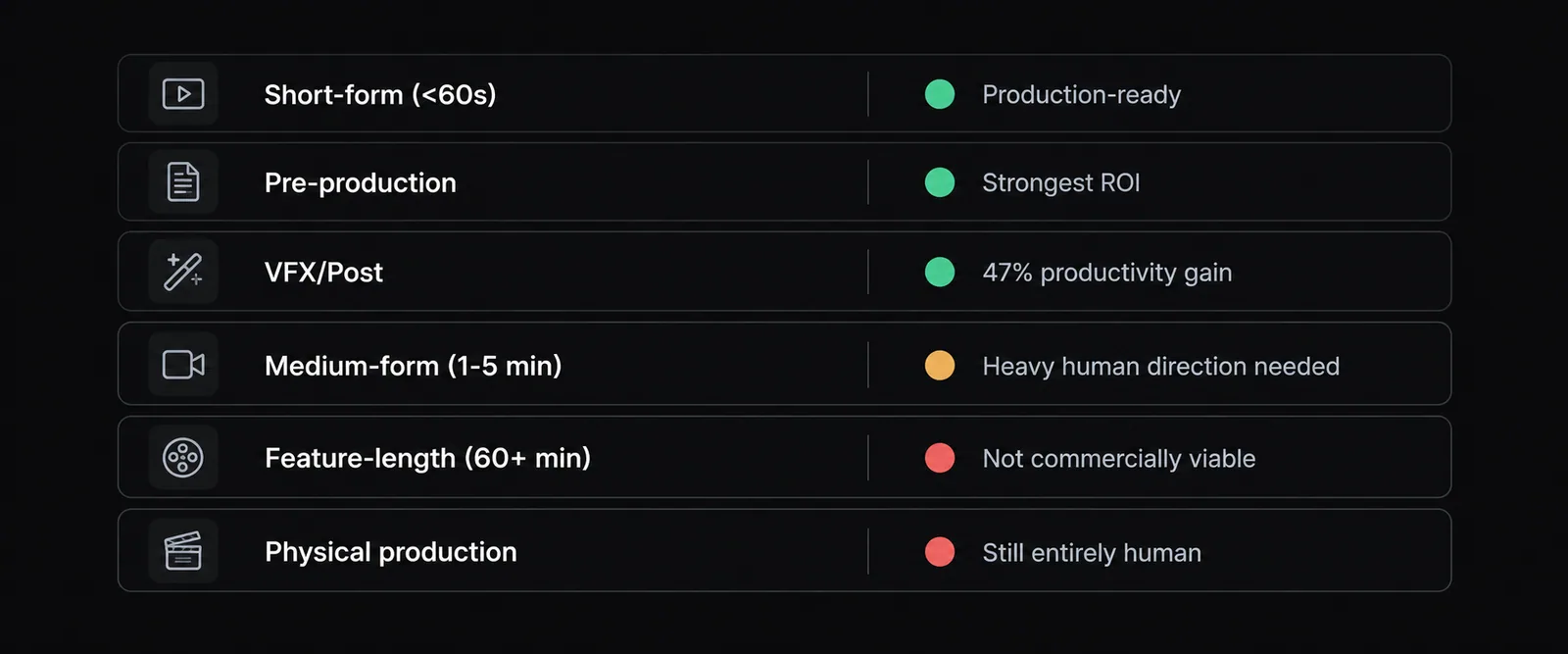
Short-form content (under 60 seconds)Works
Professional quality. Indistinguishable from real footage for many use cases. The "AI look" is increasingly rare with proper model selection and creative direction. This is where AI filmmaking has genuinely arrived. Social clips, product demos, brand films, music video segments, and ad creative all work at production quality (Apatero, 2026).
Pre-production and concept workWorks
The strongest ROI in the entire production pipeline. AI now handles mood boards, concept art, pre-visualization, storyboard generation, and reference images at a speed and cost that makes traditional methods look wasteful. Studios report pre-production timelines shrinking by 60%+ (ProductionHub, 2026).
VFX and post-production augmentationWorks
Background generation, set extension, sky replacement, de-aging, and rotoscoping are all viable with AI tools. Production teams report 47% productivity gains in editing workflows and 64% cost reduction on set design and virtual environments (Zebracat, 2026).
Medium-form content (1 to 5 minutes)Partly
Possible with significant human direction and editing. Character consistency holds for short sequences but breaks across longer cuts. AI-generated music videos, micro dramas, and spec commercials in this range are producible but require heavy post-production work to maintain coherence.
Feature-length narrative (60+ minutes)Not yet
Not commercially viable. Character persistence breaks across scenes. Eyeline matching is unreliable. Reaction shots don't match dialogue. The uncanny valley remains a problem for dialogue-driven emotional scenes. Industry analysts project this becoming viable by 2028 (Raman Media, 2026). Anyone telling you otherwise today is selling something.
Physical productionNot yet
Still entirely human. Lighting a set, directing performances, operating cameras, managing a crew. These remain the most human stage of the pipeline and are not meaningfully affected by current AI tools (ProductionHub, 2026).
What doesn't work yet (and why)
Temporal consistency across scenes
This is the single biggest limitation. AI can generate a beautiful 10-second clip of a character walking through a city. But generate a second clip of the same character sitting in a cafe, and they look like a different person. Hair changes, clothing shifts, facial proportions drift. Maintaining a consistent character across 50+ shots (the minimum for a short film) requires manual intervention on nearly every generation.
Complex human interaction
Two people having a conversation with realistic eye contact, natural gesture timing, and emotional range that matches the dialogue. AI gets close on individual shots but falls apart on the cut. Reaction shots don't match. The emotional beat drifts. Audiences feel it even when they can't articulate what's wrong (IS4.ai, 2026).
Audio-visual synchronization
Google's Veo 3.1 generates native audio alongside video, which is a genuine breakthrough. But lip-sync for dialogue, realistic ambient sound layering, and music that responds to visual beats are all still rough. The tools that solve this (like Craze, which generates voiceover and music separately and assembles on a timeline) work around the problem rather than solving it natively.
Narrative structure
AI generates moments. It does not generate stories. There is no AI tool that understands narrative structure well enough to build a 3-act film without heavy human direction. The tools that work are the ones that put a human filmmaker in the director's chair and use AI for execution, not storytelling.
The tool landscape after the Sora shakeout
The market consolidated hard in 2026. After Sora's exit, three clear lanes emerged:
| Tool | Lane | Best at | Cost | Key limitation |
|---|---|---|---|---|
| Google Veo 3.1 | Quality all-rounder | Prompt adherence, native audio, 4K/60fps | Google ecosystem | API-only, no standalone editor |
| Kling 3.0 | Value leader | Cinematic motion, multi-shot storyboard | ~$0.10/sec | Chinese platform (data concerns for some) |
| Runway Gen-4.5 | Creative control | Camera control, character persistence | $12-$96/mo | Generates clips, doesn't edit or plan |
| Seedance 2.5 | Long-form + refs | 30s single-pass, 50 multimodal refs, 4K | Included in Craze | Newer model, still proving consistency |
| Pika | Creative experimental | Stylized, short-form | $8-$58/mo | Not built for narrative work |
Notice what every tool in this table has in common: they generate clips. None of them plan the creative. None of them write a story. None of them assemble a final cut. None of them generate voiceover and music and edit it all together on a timeline.
That gap is exactly what Craze fills.
The missing middle: why clip generation isn't filmmaking
This is the thing that gets lost in every AI filmmaking conversation. Generating a clip is not making a film. A film is a sequence of directed moments, assembled with intentional pacing, scored with purposeful music, and cut to tell a specific story.
The typical AI filmmaker's workflow in 2026 looks like this: generate clips in Runway, generate voiceover in ElevenLabs, generate music in Suno or ElevenLabs Music, find sound effects somewhere, import everything into Premiere or DaVinci, and spend hours assembling a coherent edit. Five tools minimum. Hours of manual integration. And the creative direction happens in the filmmaker's head with no structure to guide it.
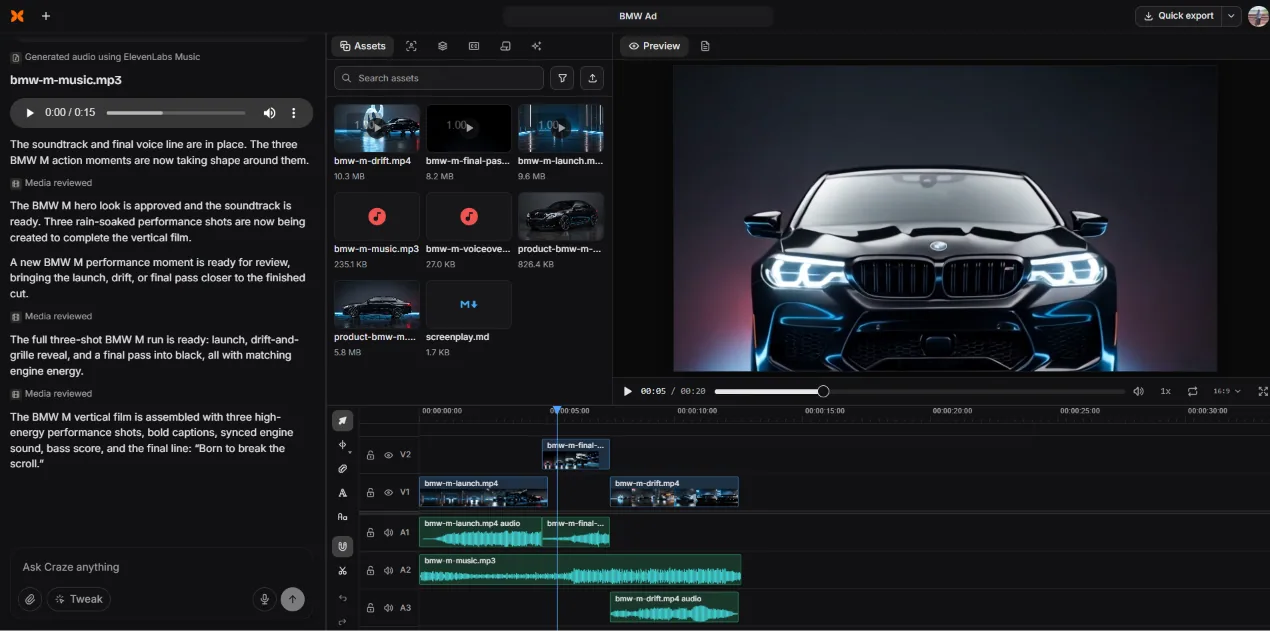
Craze compresses this into one workspace. You describe the film you want. Craze builds a story outline, generates reference images to lock the visual direction, produces video clips (Kling O3 Pro, Seedance 2.5), voiceovers (ElevenLabs V3), music (ElevenLabs Music), and product images (GPT Image 2), then assembles everything on a multi-track timeline with transitions, sound design, and captions. You refine the cut. You export.
The difference is not just convenience. It's creative coherence. When the planning, generation, and editing happen in one workflow, the result feels directed. When they happen across five disconnected tools, the result feels assembled.
The filmmaker's question: "Can AI make my film?" Wrong question. The right question: "Can AI handle the execution so I can focus on the creative?" In 2026, for short-form content, the answer is yes. For features, not yet. For everything in between, the answer depends on how much human direction you're willing to invest.
The indie filmmaker advantage
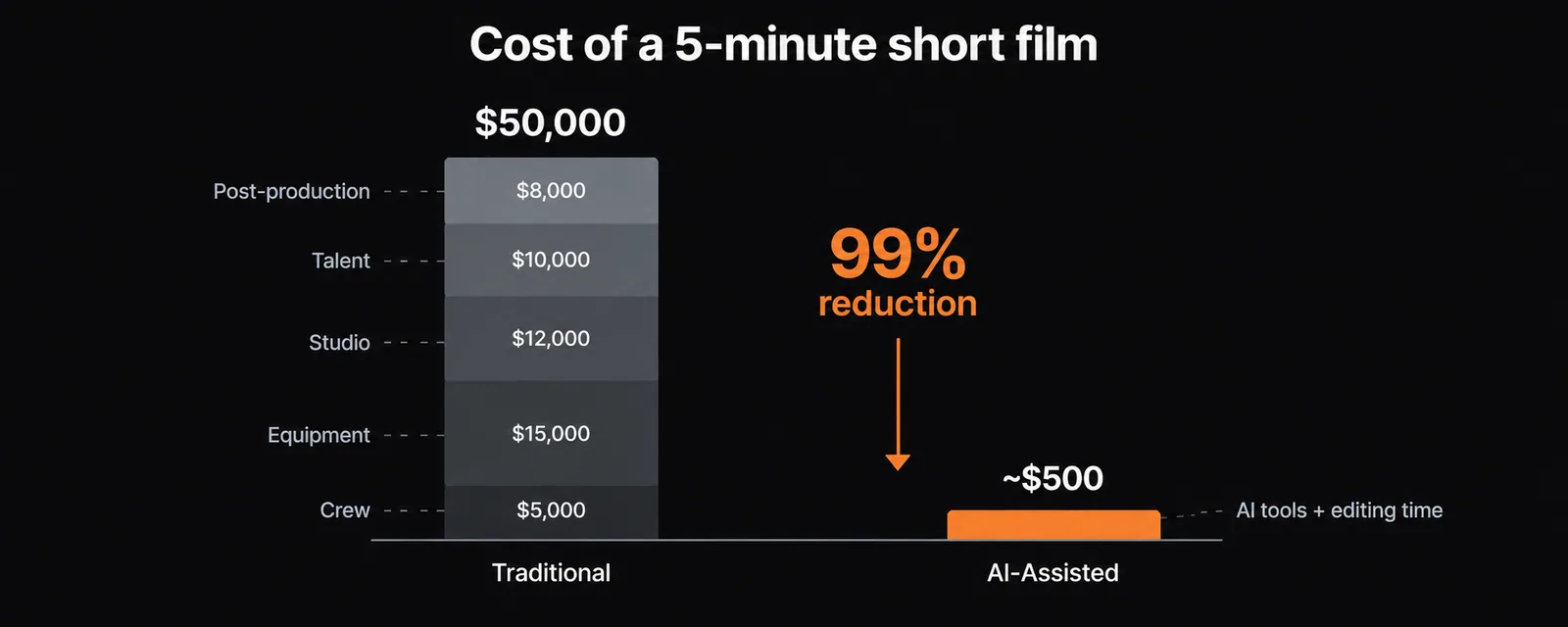
Here's the part of the AI filmmaking story that doesn't get enough attention. The cost collapse is not equally distributed. It helps independent filmmakers far more than it helps studios.
A studio that spends $200 million on a Marvel film saves a small percentage on VFX with AI tools. An indie filmmaker who previously couldn't afford any VFX now has access to capabilities that match mid-budget productions. The gap between a $500 micro-budget film and a $500,000 indie film has compressed dramatically.
AI localization tools facilitate near-instant dubbing and adaptation, allowing simultaneous international releases and breaking language-based distribution monopolies (Raman Media, 2026). An Indian filmmaker can produce a multi-language short film without a localization budget. A solo creator in Lagos can produce brand content that competes visually with a London agency.
The SAG-AFTRA AI agreements have put real guardrails around synthetic performers in union productions. But for independent and international productions working outside the studio system, AI is the most significant democratization of filmmaking tools since the DSLR revolution.
What's coming (the measured version)
Temporal consistency will improve significantly. Multi-shot character persistence is the top priority for every major AI video lab. Kling 3.0's storyboard mode and Runway's character locking are early versions of what will become table stakes by mid-2027.
Native audio will become universal. Google's Veo 3.1 proved that synchronized audio generation works. Expect every serious competitor to ship native audio within the next two model generations.
The price per usable clip will fall below $0.05. It's already at roughly $0.10 per second on Kling. The trajectory points toward generation becoming effectively free, with revenue shifting to editing, workflow, and distribution tools.
AI-integrated feature films will ship by 2028, but not in 2026. The projection from multiple credible sources puts commercially viable AI-integrated features at roughly two years out. That means heavily AI-assisted, not fully AI-generated. Human directors, writers, and performers at the core. AI handling VFX, environments, and select footage.
The tools that survive will be the ones that ship finished work, not clips. Sora died because it generated clips without a workflow. The tools that thrive will be the ones that connect creative direction to generation to editing to export. This is the bet Craze is making, and it's the bet that the market data supports.
Stop generating clips. Start directing films.
Craze handles creative direction, AI generation, and editing in one workspace. Brief to final cut in minutes, not weeks.
$19/month flat. Unlimited exports.
Related reading:
How Agencies Use AI Video to Deliver 10x More Creative
AI Video for Social Media: TikTok, Reels & Shorts at Scale
Craze vs Descript vs CapCut