
How Agencies Use AI Video to Deliver 10x More Creative at Half the Cost
The agencies winning in 2026 are not hiring bigger production teams. They are building AI-first video workflows that let a four-person creative team outproduce a traditional 20-person pipeline.

The numbers agencies can't ignore
The data on AI video adoption in agencies has gone from "interesting experiment" to "existential competitive advantage" in a single year.
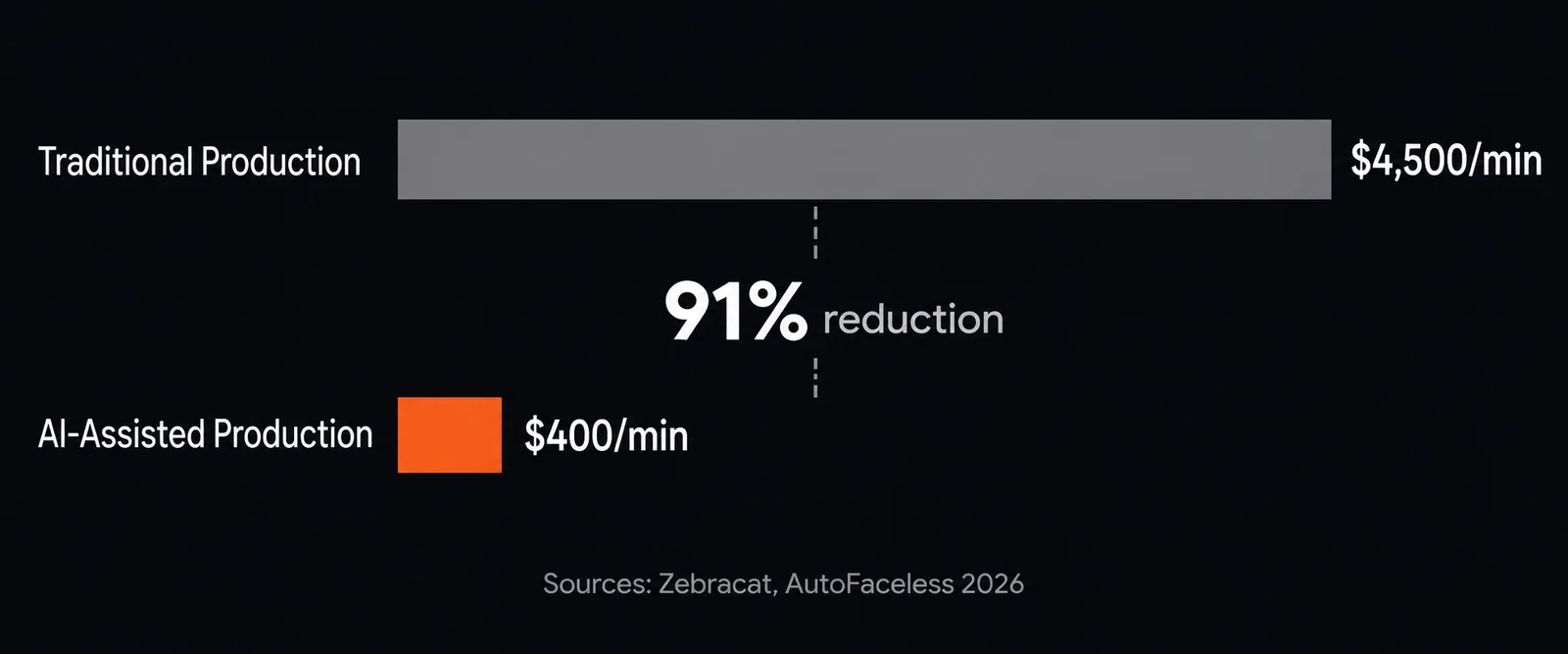
AI-equipped agencies produce 11x more video content per month without expanding teams (Zebracat, 2026). Traditional production costs roughly $4,500 per finished minute; AI-assisted production brings that to approximately $400, a 91% reduction (AutoFaceless, 2026). The average 60-second marketing video that took 13 days through traditional production now takes approximately 27 minutes.
And the adoption curve has crossed the tipping point. 86% of ad buyers are using or planning to use generative AI for video ad creative in 2026 (Sovran, 2026). 78% of marketing teams already incorporate AI-generated video into campaigns. 57% of creative agencies report at least a 38% reduction in production timelines.
These are not projections. These are measurements from agencies that have already restructured their workflows. The performance gap between AI-first agencies and traditional agencies widens with every quarter (AI Content Drop, 2026).
Why the old agency production model is breaking
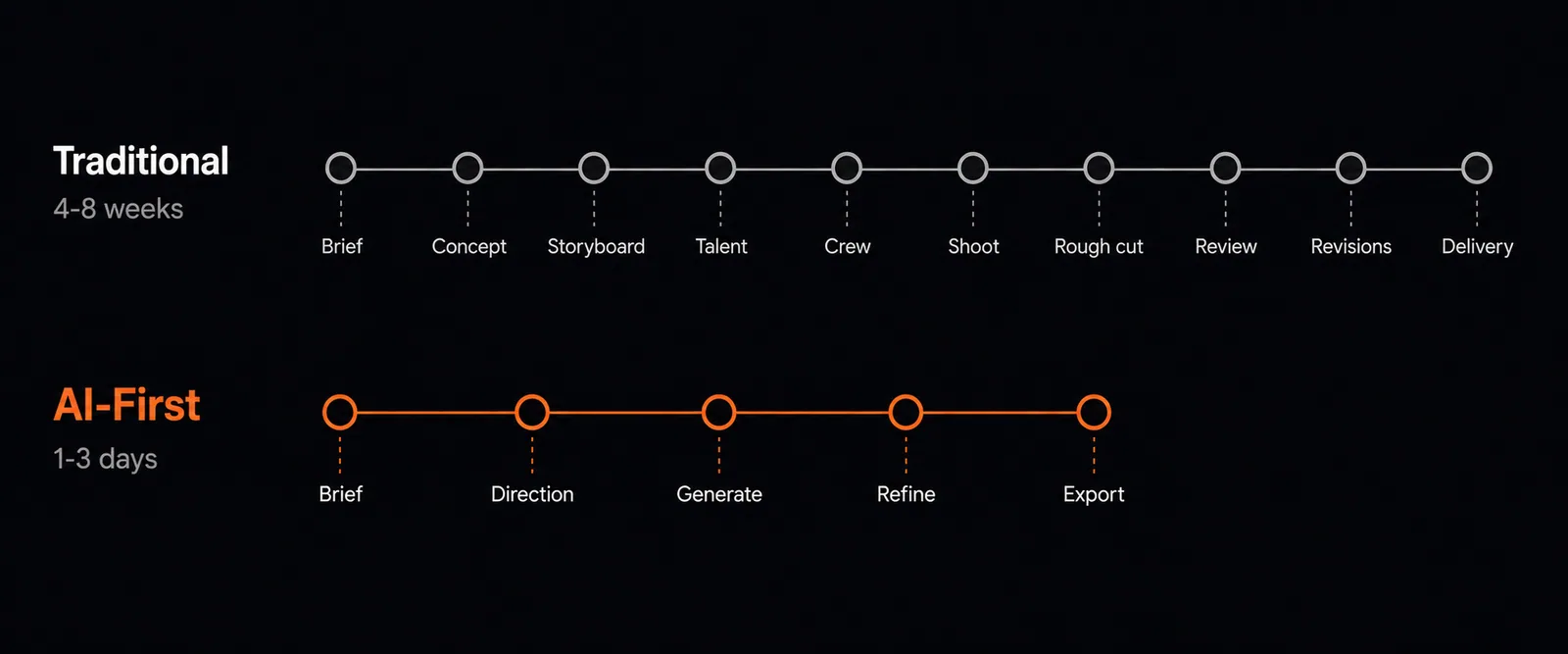
Traditional video production at agencies follows a well-worn path: creative brief, concept development, storyboarding, talent booking, crew hiring, location scouting, shoot days, rough cut, client review, revisions, color/sound, final delivery. Each step involves different people, different timelines, and different costs.
For a standard 30-second brand video, the timeline runs 4 to 8 weeks from brief to delivery. The cost ranges from $5,000 to $15,000 for a mid-tier agency, and $50,000+ for premium work. Most of that budget goes to crew, equipment, studio, and talent, not creative thinking.
This model worked when brands needed two or three hero videos per quarter. It does not work when they need 20 to 50 creative variants per campaign to beat ad fatigue, or when a TikTok trend needs a response the same day, not next month.
Three forces are breaking the old model simultaneously:
- Platform volume demands. TikTok, Reels, and Shorts reward posting 4 to 7 times per week per platform. A brand active on three platforms needs 50+ videos per month.
- Creative fatigue cycles. Performance ads lose 50% of their effectiveness within 3 to 5 days. The only response is constant fresh creative.
- Client budget compression. Marketing budgets are flat or shrinking. Clients expect more output for the same spend.
The agencies that are growing in this environment are the ones that have rebuilt their production pipeline around AI.
What the AI-first agency model looks like
The agencies seeing the biggest gains are not bolting AI onto their existing process. They are restructuring entire workflows around it. The ones reporting 60 to 75% cost reductions are the ones that went AI-first rather than AI-supplemental (Adwave, 2026).
The shift changes the team structure. A traditional video pipeline for one brand campaign might involve a creative director, copywriter, storyboard artist, producer, director, DP, sound engineer, colorist, and editor. An AI-first pipeline for the same campaign needs a creative director, an AI-fluent editor, and a strategist. The creative thinking stays human. The production execution moves to AI.
This does not mean lower quality. It means reallocating where human time goes. Instead of spending 80% of project hours on production logistics and 20% on creative thinking, AI-first agencies flip that ratio. More time on strategy, concept, and creative direction. Less time coordinating shoots, managing footage, and cutting takes.
Key distinction: The agencies getting the most from AI are not replacing creative directors with AI. They are replacing production pipelines with AI. The creative director still shapes the vision. AI handles the execution. This is why Craze's workflow is built around creative direction, not prompting: you direct the video the way you would direct an editor, and AI handles the heavy lifting.
The agency workflow: brief to delivery in hours
Here is the workflow we see working at agencies using Craze for client video production. The same framework applies whether the deliverable is a brand film, product demo, ad campaign, or social content package.
1. Creative brief and direction (30 minutes)
The account team writes a creative brief the way they always have: client objectives, audience, tone, platform, deliverables. The difference: instead of passing that brief to a production team that takes two weeks to come back with a treatment, the creative director opens a Craze project and describes the video in plain language.
Craze interprets the brief, asks clarifying questions (format, visual style, tone), and builds a story outline with scene breakdowns and a closing line. It generates reference images to lock the visual direction. The CD reviews and approves before any footage is produced.
2. Asset generation (15-30 minutes)
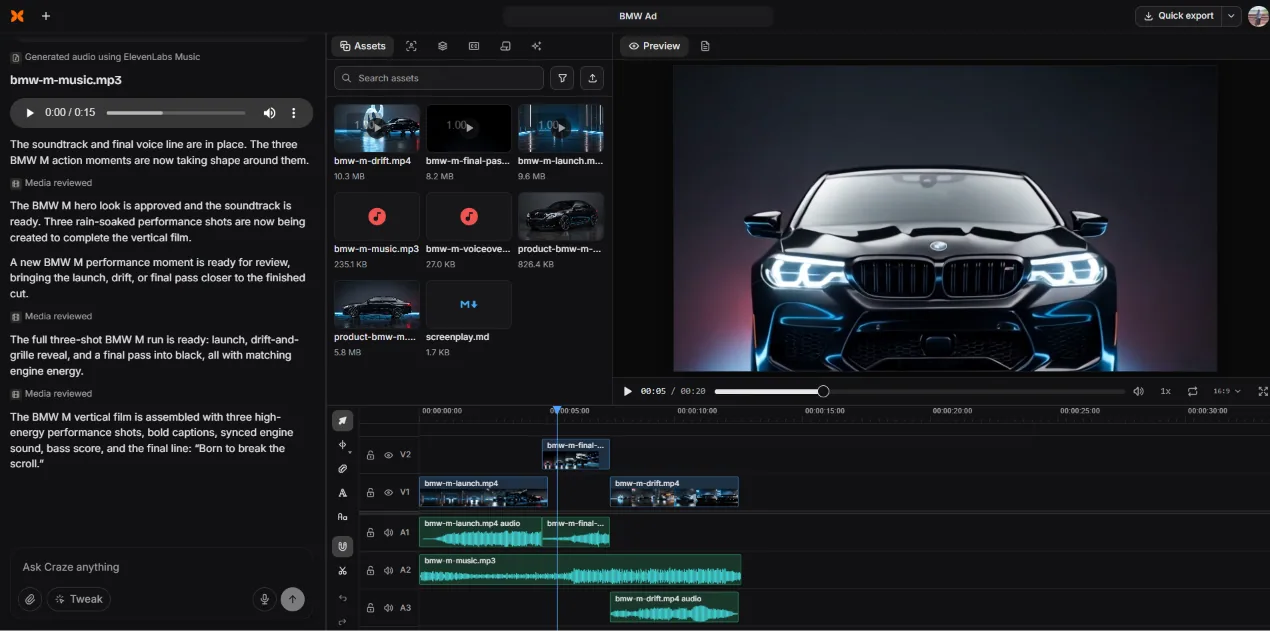
Once the creative is locked, Craze generates all assets: video clips (Kling O3 Pro, Seedance 2.5), voiceovers (ElevenLabs V3), background music (ElevenLabs Music), and product or scene images (GPT Image 2). Everything appears in the project panel for review.
3. Assembly and refinement (30-60 minutes)
Craze assembles the assets on a multi-track timeline (V1/V2 for video, A1-A3 for audio) with captions, transitions, and sound design already in place. The editor reviews the cut, fine-tunes timing, applies transitions, adjusts color presets, and adds sound effects from the built-in library.
4. Variant production (15 minutes per variant)
This is where the AI model truly changes agency economics. Creating a variant (different hook, different closing CTA, different music, different aspect ratio) takes 15 minutes, not a full re-production. A five-variant campaign that would cost $25,000+ in traditional production costs the same $19/month flat subscription.
5. Client review and export (10 minutes)
Export in whatever format the client needs: 9:16 for TikTok/Reels, 16:9 for YouTube, 1:1 for feed. Unlimited exports are included. Revisions follow the same fast cycle: adjust the direction, regenerate or re-edit, export.
Five agency use cases where AI video works best
1. Performance ad creative at volume
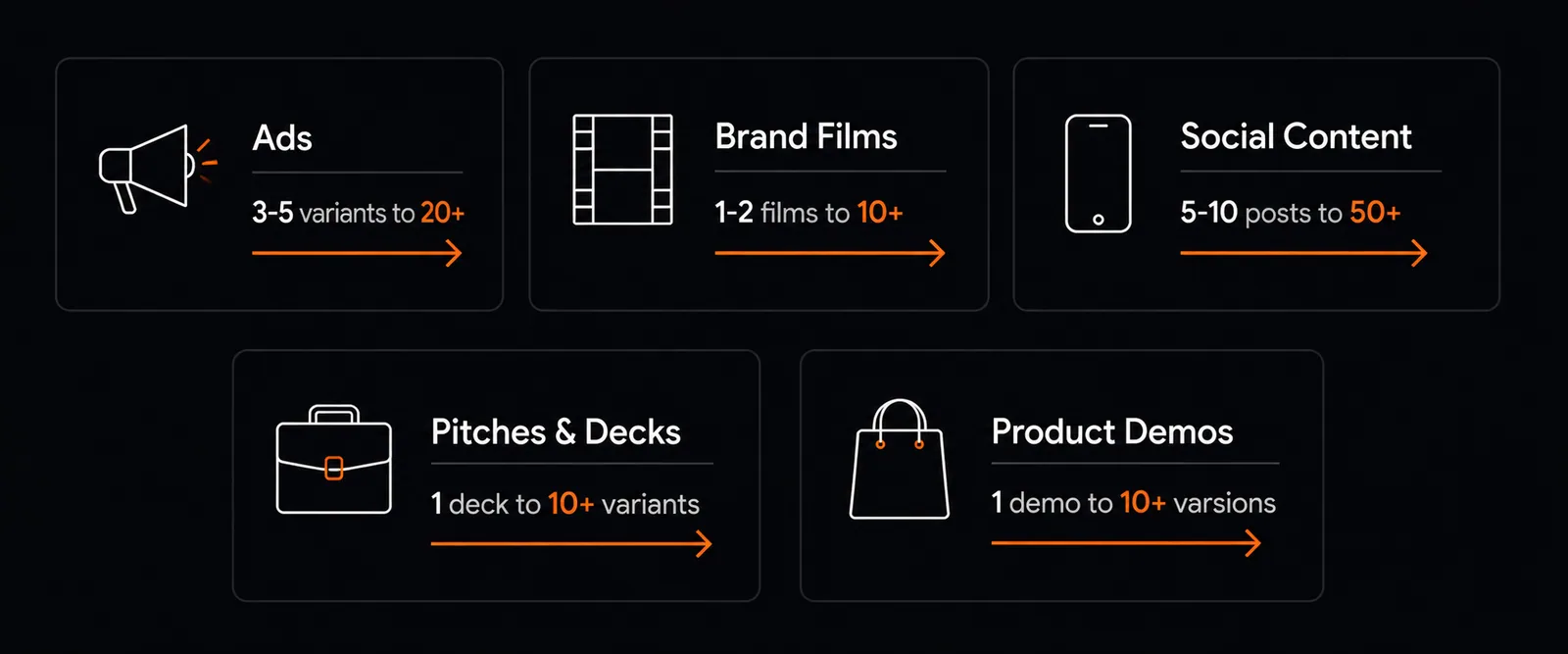
Performance marketing lives and dies on creative volume. Only 5 to 10% of tested ad creatives actually scale (Sovran, 2026). The more variants you test, the more likely you are to find a winner. AI makes 20+ variants per campaign viable instead of 3 to 5.
Creative quality accounts for 56% of sales lift from digital ad campaigns, more than media placement or targeting combined (Nielsen data via Sovran). Agencies that can test more creative, faster, find winners faster.
2. Brand films and product launches
A brand launch video that takes 6 weeks and $30,000 through traditional production can be produced in 1 to 2 days for a fraction of the cost. The creative direction stays the same. The execution compresses.
3. Social content packages
Agencies managing social accounts for multiple clients need to produce 50 to 100+ pieces per month. AI tools make this volume viable for small teams without sacrificing quality. One creative director can manage 5 to 8 client accounts when AI handles production.
4. Pitch decks and spec work
Agencies burn significant hours producing spec creative for new business pitches. AI lets you produce polished concept videos for a pitch in hours instead of days, dramatically reducing the cost of new business development.
5. Product demos and e-commerce
E-commerce clients with hundreds of SKUs need product video at catalog scale. Traditional production covers 10 to 20 products per budget cycle. AI covers 100+. Product pages with video convert 65% higher than those without (WebFX via Rocketium, 2026).
The economics: what this actually means for margin
Here is what the numbers look like for a mid-size agency producing video for a typical brand client.
| Line item | Traditional | AI-first (Craze) |
|---|---|---|
| Monthly video output | 4 to 6 videos | 20 to 40 videos |
| Team required | 6 to 10 people | 2 to 3 people |
| Production cost/month | $15,000 to $40,000 | $500 to $2,000 |
| Time: brief to delivery | 2 to 6 weeks | 1 to 3 days |
| Variant cost | $2,000 to $5,000 each | ~15 min + $0 marginal |
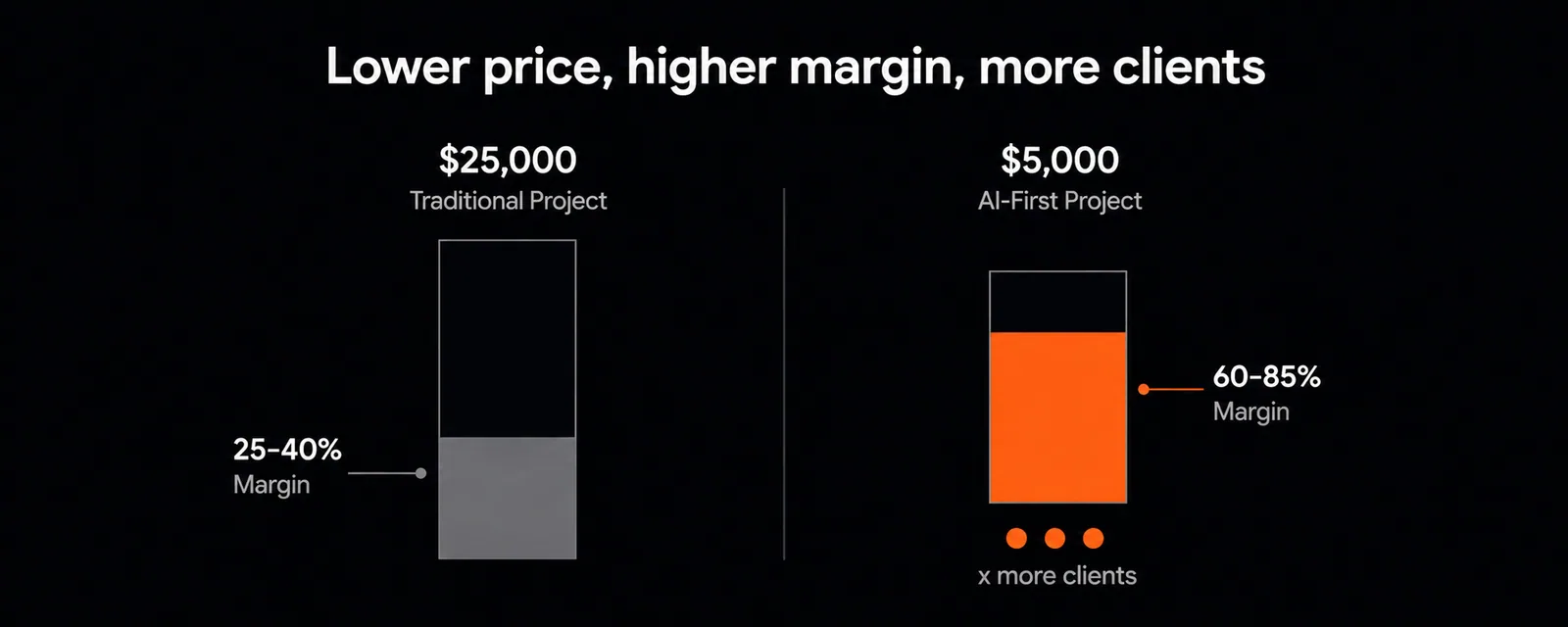
| Client can be charged | $20,000 to $60,000 | $5,000 to $15,000 |
| Effective margin | 25 to 40% | 60 to 85% |
The math is counterintuitive. Even though AI-first agencies charge clients less per project, their margins are higher because the production cost is near zero. A project that costs $15,000 in traditional production and bills at $25,000 (40% margin) becomes a project that costs $500 in AI production and bills at $5,000 (90% margin).
The agencies growing fastest in 2026 are using this margin advantage in two ways: winning more clients by undercutting traditional agencies on price, and increasing profitability per client by delivering more output at the same or lower cost.
Best AI video tools for agency workflows
Not every AI tool fits an agency workflow. Agencies need multi-client management, brand-safe output, variant production, and predictable pricing. Here is what works.
Craze handles the full agency pipeline: creative direction, AI generation (video, voiceover, music, images), and professional timeline editing. The $19/month flat pricing per user with no per-project fees makes budgeting simple. For agencies producing brand films, ads, product demos, and social content across multiple clients, Craze is the closest thing to a one-tool solution.
Runway produces the highest-quality standalone AI footage. Agencies use it for hero shots and B-roll that needs to look cinematic. The limitation: Runway generates clips but does not plan, edit, or assemble. You take the footage into a separate editor. Credit-based pricing ($12 to $96/month) can spike on large campaigns.
Descript handles podcast and interview editing for agencies managing audio-first clients. Transcript editing, Studio Sound, and Overdub voice cloning are unmatched for spoken content. It does not generate footage.
CapCut works for agencies making quick social clips from existing footage. The free tier is strong. The ByteDance content licensing terms and paywall creep are downsides for commercial brand work.
The agency stack in practice: Most AI-first agencies use Craze as the primary production tool (brief-to-finished-video), Runway for specific cinematic shots, and Descript for podcast clients. The days of needing five separate tools plus a freelance editor are over for most campaign types.
Honest objections (and honest answers)
"Clients won't accept AI-generated video." Most clients care about results, not production method. If the video performs, they do not ask whether a human or an AI held the camera. That said, transparency matters. The agencies doing this well tell clients they use AI tools and position it as a cost and speed advantage.
"The quality isn't there yet." For certain use cases, this is true. Complex multi-actor dialogue scenes, precise product photography that needs to match physical inventory, and broadcast-grade finishing still benefit from traditional production. For social content, performance ads, product demos, brand films, and explainer videos, AI quality is already at or above what most clients expect.
"It will commoditize our services." The opposite. AI raises the floor (basic video becomes cheap and accessible) but also raises the ceiling (creative direction becomes more valuable, not less). Agencies that compete on production execution will lose to AI. Agencies that compete on creative strategy and direction will win bigger.
"Our team doesn't know how to use these tools." The learning curve for creative-direction-first tools like Craze is measured in hours, not weeks. If your team can write a creative brief, they can direct an AI video. The skills that matter are taste, narrative instinct, and brand understanding, all of which your team already has.
Build your agency's AI video workflow
Craze handles creative direction, AI generation, and editing in one workspace. $19/month flat per user. No per-project fees. Unlimited exports.
Related reading:
How to Create UGC Videos with AI
AI Video for Social Media: TikTok, Reels & Shorts at Scale
Can AI Video Actually Sell Products?