
AI Video for Social Media: How to Make TikTok, Reels & Shorts at Scale
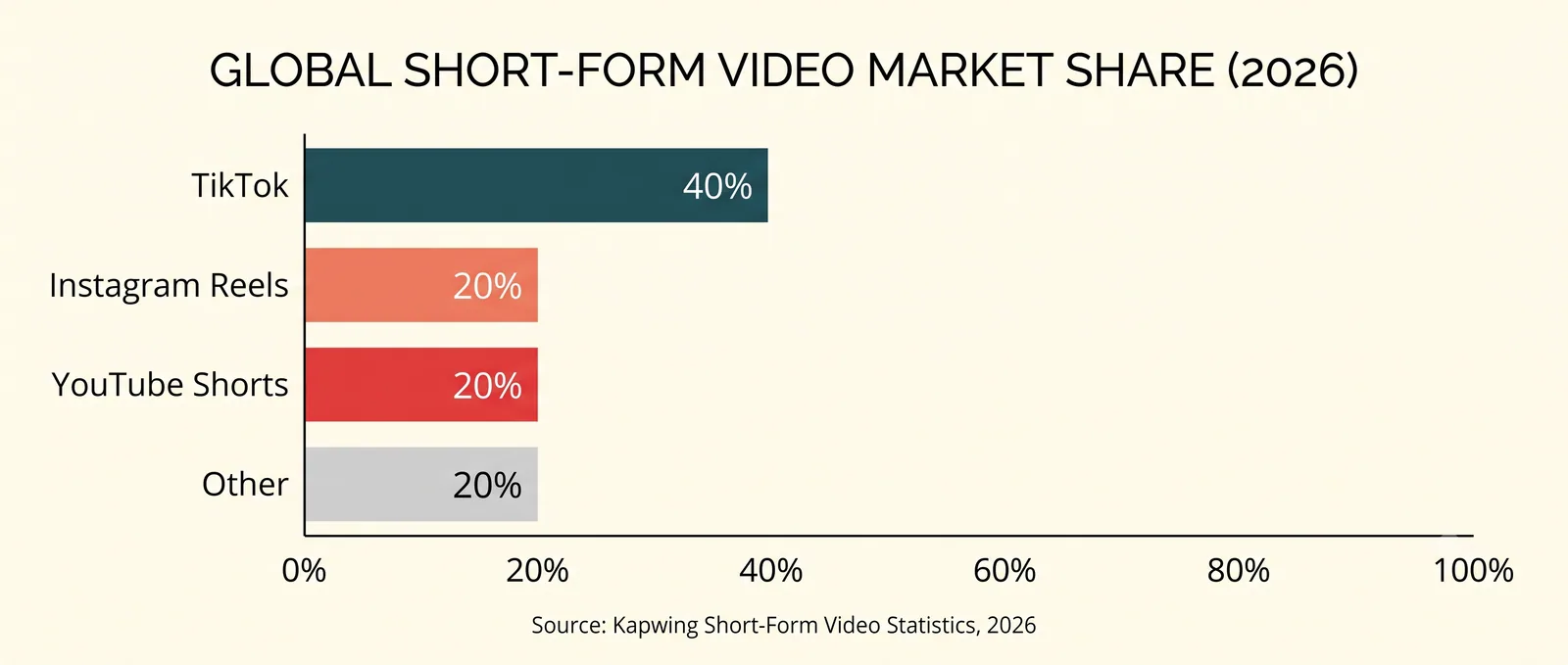
Short-form video takes 58% of all time spent on social media. Brands that can produce it consistently win. Brands that can't fall behind. Here's how AI makes the volume viable without burning out your team.

Why short-form video is the only format that matters right now
Every marketing team knows short-form video is important. But the numbers for 2026 make the case impossible to ignore.
Short-form video is the number one ROI-driving content format, ranked first by 49% of marketers, beating long-form video at 29% (HubSpot State of Marketing 2026). YouTube Shorts averages 200 billion daily views. TikTok users spend an average of 1 hour 37 minutes per day on the app. Instagram Reel ads generate 41% higher click-through rates compared to static ads (Kapwing, July 2026).
And here's the stat that matters most for anyone selling anything: 64% of consumers are more likely to buy after watching a short product video (WiFi Talents, 2026).
The platforms are clear about what they want. TikTok, Instagram, and YouTube are all prioritizing short-form video in their algorithms. Brands that show up consistently in this format get rewarded with reach. Brands that post once a week and disappear get algorithmically punished.
That's where the problem starts.
Platform specs: TikTok vs Reels vs Shorts
Before you start producing, you need to know what each platform actually requires and rewards. The specs are similar but the nuances matter.
| Spec | TikTok | Instagram Reels | YouTube Shorts |
|---|---|---|---|
| Aspect ratio | 9:16 vertical | 9:16 vertical | 9:16 vertical |
| Max length | 10 minutes | 3 minutes | 3 minutes |
| Sweet spot | 15 to 60 seconds | 15 to 30 seconds | 30 to 60 seconds |
| Resolution | 1080x1920 px | 1080x1920 px | 1080x1920 px |
| Captions | Critical (85% watch muted) | Critical | Important |
| Discovery model | For You page (interest-based) | Explore + non-follower reach | Shorts shelf + Search |
| Best for | Trends, hooks, raw energy | Polish, brand aesthetics | Evergreen, searchable |
| Engagement rate | 2.80% (Socialinsider) | 0.65% (Socialinsider) | 5.91% by views (Marketing LTB) |
The key takeaway: all three platforms use the same vertical format, but they reward different creative approaches. TikTok favors raw, fast content that hooks in the first second. Reels favor polished, brand-safe aesthetics. Shorts benefit from evergreen, searchable content that lives longer (Postplanify, April 2026).
Most brands try to create one video and cross-post it everywhere. This works for reach but underperforms compared to platform-native content. The teams that win are producing variations tuned to each platform's algorithm.
That takes volume. And volume is exactly what most teams can't afford with traditional production.
The production problem: why most brands can't keep up
The math is simple and brutal. To perform well on short-form, you need to post 4 to 7 times per week on TikTok and 3 to 5 times on Reels and Shorts. That's 10 to 17 videos per week if you are active on all three platforms. Roughly 50 to 70 videos per month.
Traditional production costs $500 to $5,000 per short social clip through a freelancer or agency (Sovran, March 2026). Even at the low end, 50 clips per month at $500 each is $25,000 per month in production costs alone. Most marketing teams don't have that budget. So they post two or three times a week, lose algorithmic momentum, and wonder why their social presence stalls.
The problem isn't strategy. It's throughput.
The real bottleneck: It's not that brands don't know what to post. It's that they can't produce enough of it fast enough. Creative fatigue hits hard on short-form because the algorithm demands constant fresh content. AI doesn't just reduce cost. It changes the production cadence from "one video every few days" to "multiple variations per afternoon."
How AI changes the math
AI video tools reduce production costs by 70 to 90% compared to traditional methods (Q'dUp, April 2026). A social media campaign that costs $10,000 to $30,000 through a full-service agency can be produced for a few hundred dollars in platform fees.
But cost reduction is only half the story. The bigger shift is speed. A video that takes a freelancer 3 to 5 days (brief, film, edit, revisions, delivery) takes 15 to 45 minutes with AI creative direction tools. That speed difference is what makes posting 5x per week realistic for a two-person marketing team.
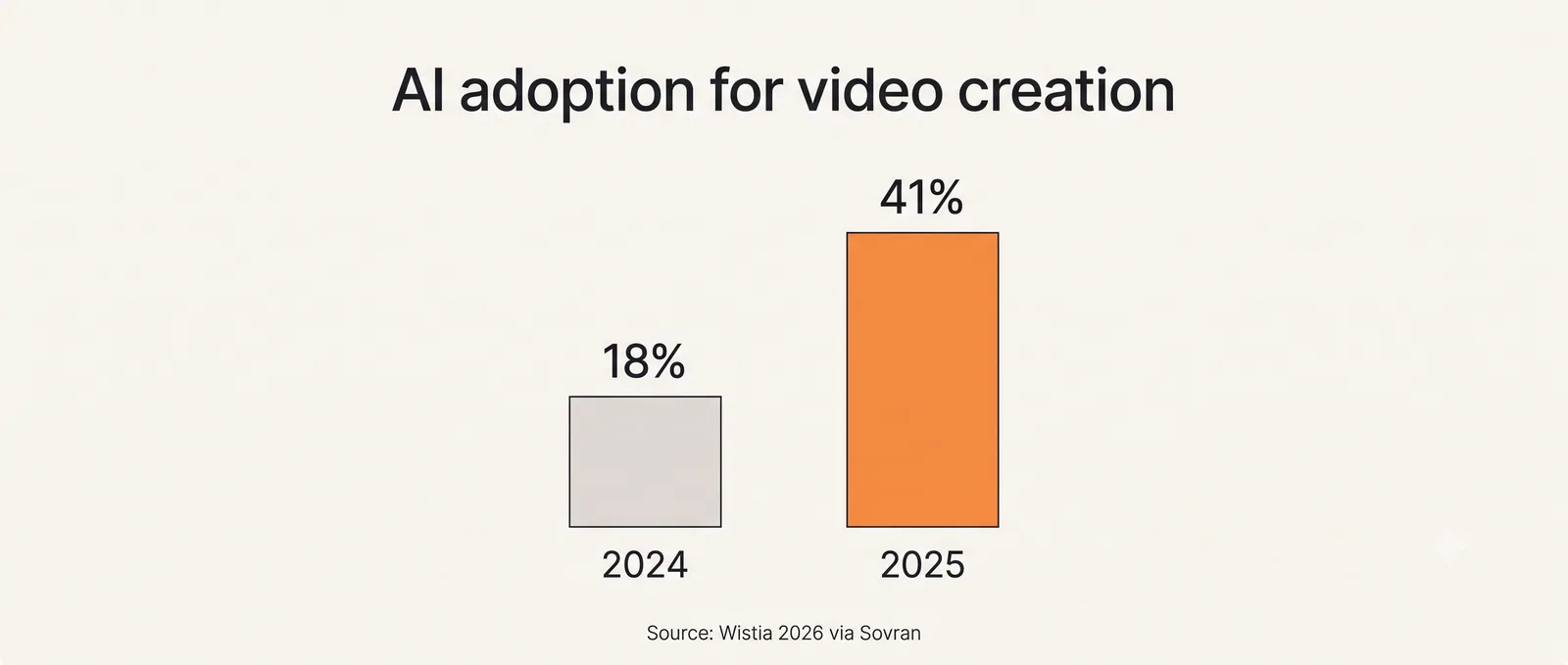
Wistia's 2026 data shows AI adoption for video creation more than doubled in a single year, from 18% to 41% of brands. The IAB projects that AI-created ads will reach 40% of all ads by 2026. This isn't early-adopter territory anymore. It's becoming standard operating procedure.
The question is no longer "should we use AI for social video?" It's "which AI workflow actually produces content good enough to post?"
The 5-step AI workflow for social video at scale
Here's the workflow we use with Craze to produce social video at volume. The same framework works whether you are making product demos, brand content, or trend-driven social clips.
Step 1: Write a brief, not a script
Open a new project in Craze and describe the video in plain language. Include the product, audience, platform, aspect ratio, and tone. Example: "A 15-second vertical product reveal for our new headphones, for TikTok, energetic and premium, hook in the first 2 seconds."
Craze interprets your brief, asks clarifying questions with recommended answers, and shapes it into a refined creative direction. This is not prompting. You are giving creative notes the way you would to an editor.
Step 2: Lock the story and visual direction
Craze writes a story outline with scene breakdowns: opening hook, action beats, closing line. It generates reference images to lock the visual identity (lighting, color palette, product styling). You approve or revise before any footage is generated.
This planning step is what separates good AI video from random AI clips. Skipping it produces generic content. Doing it well produces videos that look intentional.
Step 3: Generate all assets
Once the creative is locked, Craze generates video clips using Kling O3 Pro and Seedance 2.5, voiceovers using ElevenLabs V3, background music using ElevenLabs Music, and product images using GPT Image 2. Everything appears in the project panel for review.
Step 4: Refine the assembled cut
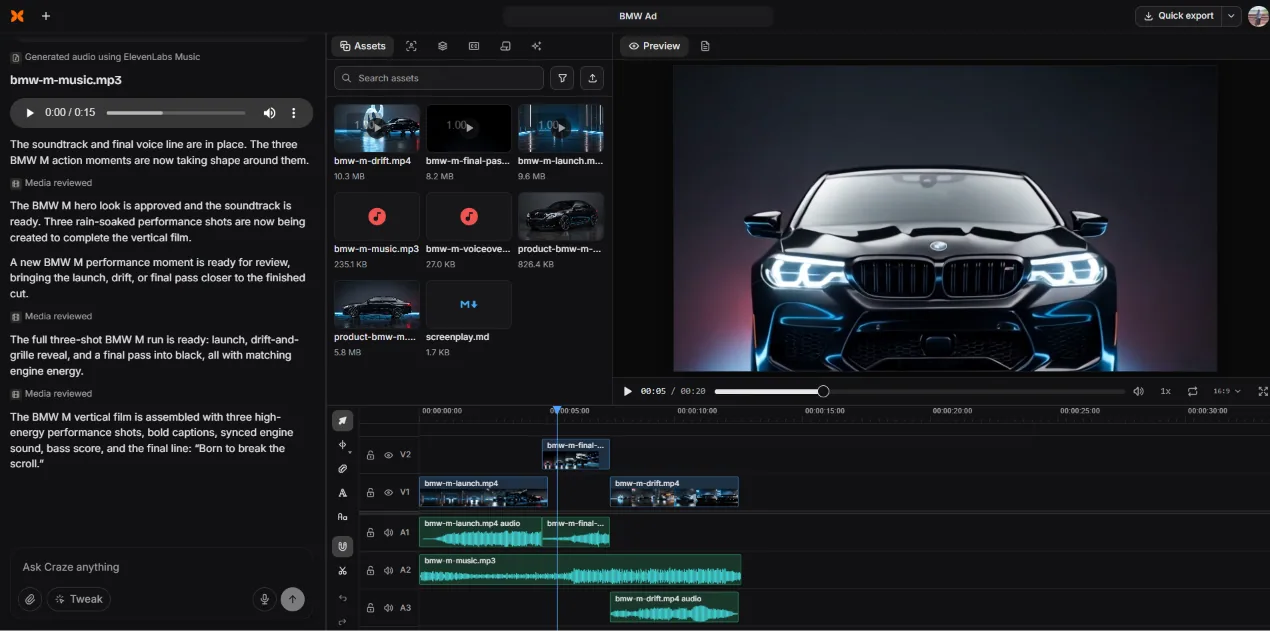
Craze assembles the assets on a multi-track timeline (V1/V2 for video, A1-A3 for audio) with captions, transitions, and sound design already in place. You review the preview, then fine-tune: adjust timing with ripple edits, apply transitions, add sound effects from the built-in library, and adjust color presets.
Step 5: Export, post, and create the next variant
Export in 9:16 vertical for TikTok and Reels, or 16:9 for YouTube long-form. Unlimited exports are included in the $19/month plan. Need a variant with a different hook? Go back to step 2, change the opening, and export a new version in minutes.
The variant advantage: The real power of AI isn't making one perfect video. It's making five variations of that video in the same session: different hooks, different closing lines, different music. You test all five, kill the underperformers, and iterate from the winner. That's how performance marketers think about short-form, and AI is the only way to do it at a viable cost.
What actually works on each platform
TikTok: hook fast, move fast
TikTok's algorithm makes its decision in the first 1 to 2 seconds. If viewers don't stop scrolling, the video is dead. The hook is everything. Strong opening patterns include: a visual surprise (something unexpected in frame), a bold text overlay with a provocative claim, or an extreme close-up that pulls into a reveal.
The average TikTok upload runs 42.7 seconds (Vidico, 2026). Videos over 54 seconds average roughly 38,000 views; videos under 10 seconds average about 19,000. The sweet spot for most brands is 15 to 45 seconds: long enough to say something, short enough to hold attention.
AI tools are particularly good at TikTok content because they can produce impossible camera angles, cinematic lighting, and visual effects that would require a production crew in real life. A product floating in zero gravity, a shoe exploding into particles, a car drifting through neon rain. These are the visuals that stop the scroll, and AI generates them in minutes.
Instagram Reels: polish and brand
Reels reward aesthetics more than TikTok does. The audience skews slightly older and more brand-conscious. Clean transitions, consistent color grading, and on-brand typography perform well. Reel ads get 41% higher CTR than static ads, which means brands investing in polished Reels content see direct returns.
Reels get 36% more reach than carousels (Buffer 2026 analysis via Postplanify), making them the best format for discovery. But carousels generate 109% more engagement per person reached. Smart brands use Reels for reach and carousels for depth, not one or the other.
YouTube Shorts: searchable and evergreen
Shorts benefit from YouTube's search engine. Unlike TikTok and Reels, where content has a 24-to-72-hour shelf life, a well-optimized Short can drive views for months through search and recommendations. Educational content, how-tos, and "did you know" formats perform especially well.
YouTube Shorts commands the highest engagement rate among short-form formats at 5.91% when measured by likes, comments, and shares relative to views. And with YouTube's monetization system, Shorts can generate direct revenue for eligible creators.
Best AI tools for social video production
Not every AI video tool is built for social. Some generate footage but don't edit. Some edit but don't generate. Here's what actually works for the short-form social workflow.
Craze handles the full pipeline: creative planning, AI video and audio generation, and a professional timeline editor. It builds your video from a brief, not from existing footage. Best for brands, agencies, and creators who need to produce social content from ideas rather than recordings. $19/month flat, unlimited exports.
CapCut is the strongest free editor for social clips. If you already have footage from your phone and want to add templates, captions, and transitions, CapCut's free tier is unbeatable. It doesn't generate footage, but it makes existing clips look polished fast.
Descript works best if your social content starts as talking-head recordings, podcast clips, or interviews. Its transcript-based editing and filler word removal are perfect for repurposing long-form into short clips.
Runway generates the highest-quality individual AI clips, but doesn't edit or assemble. Useful if you want AI footage as B-roll for an existing editing workflow.
Which tool when: If you're starting from scratch (no footage, just an idea): Craze. If you're editing existing recordings: Descript for dialogue, CapCut for visual clips. If you need raw AI footage to feed into your NLE: Runway. Most teams at scale use two of these together.
Mistakes that tank short-form performance
Cross-posting the same video everywhere. TikTok, Reels, and Shorts have different audiences and algorithms. A TikTok that performs well might underperform on Reels because the pacing is wrong or the aesthetic doesn't match. Create platform-tuned variations, not carbon copies.
Ignoring the hook. The first two seconds determine whether your video gets watched or skipped. Most brands waste these seconds on a logo reveal or a slow fade-in. Start with the most interesting visual or claim, not the brand name.
Posting without captions. An estimated 85% of social video is watched without sound. If your message only works with audio, you're losing most of your audience. Always add captions. Craze, CapCut, and Descript all handle this automatically.
Over-producing. Short-form video works because it doesn't feel like a Super Bowl commercial. If your AI-generated video looks too polished, too cinematic, too perfect, it loses the scroll-stopping quality that makes short-form effective. Leave texture. Keep it snappy. Let it feel human.
Posting inconsistently. The algorithms reward consistency over quality. Three decent videos per week beats one incredible video every two weeks. AI tools exist specifically to solve this problem: they make consistent output viable for small teams.
The economics: what scaling social video actually costs
Here's what the numbers look like for a brand posting 5 videos per week across three platforms (15 platform-tuned videos per month, derived from roughly 5 core concepts with variations).
| Method | Cost per video | Monthly total (15 videos) | Time per video |
|---|---|---|---|
| Agency production | $1,000 to $5,000 | $15,000 to $75,000 | 5 to 14 days |
| Freelancer | $500 to $2,000 | $7,500 to $30,000 | 3 to 7 days |
| UGC creator | $150 to $500 | $2,250 to $7,500 | 5 to 10 days |
| AI with Craze | ~$4 to $10 | $19/mo flat | 3 to 10 minutes |
The cost difference is dramatic enough on its own. But the speed difference is what changes the strategy. When a video takes 15 minutes instead of 5 days, you can produce variants, test hooks, kill underperformers, and iterate from winners in the same week. That iterative speed is how performance marketing teams find the 5 to 10% of creatives that actually scale (Sovran, March 2026).
Start making social video with AI
Craze plans, generates, and edits your TikToks, Reels, and Shorts from a creative brief.
$19/month, flat. No tiers. Unlimited exports.
Frequently asked questions
Related reading on Craze:
How to Create UGC Videos with AI
Best VEED Alternatives in 2026